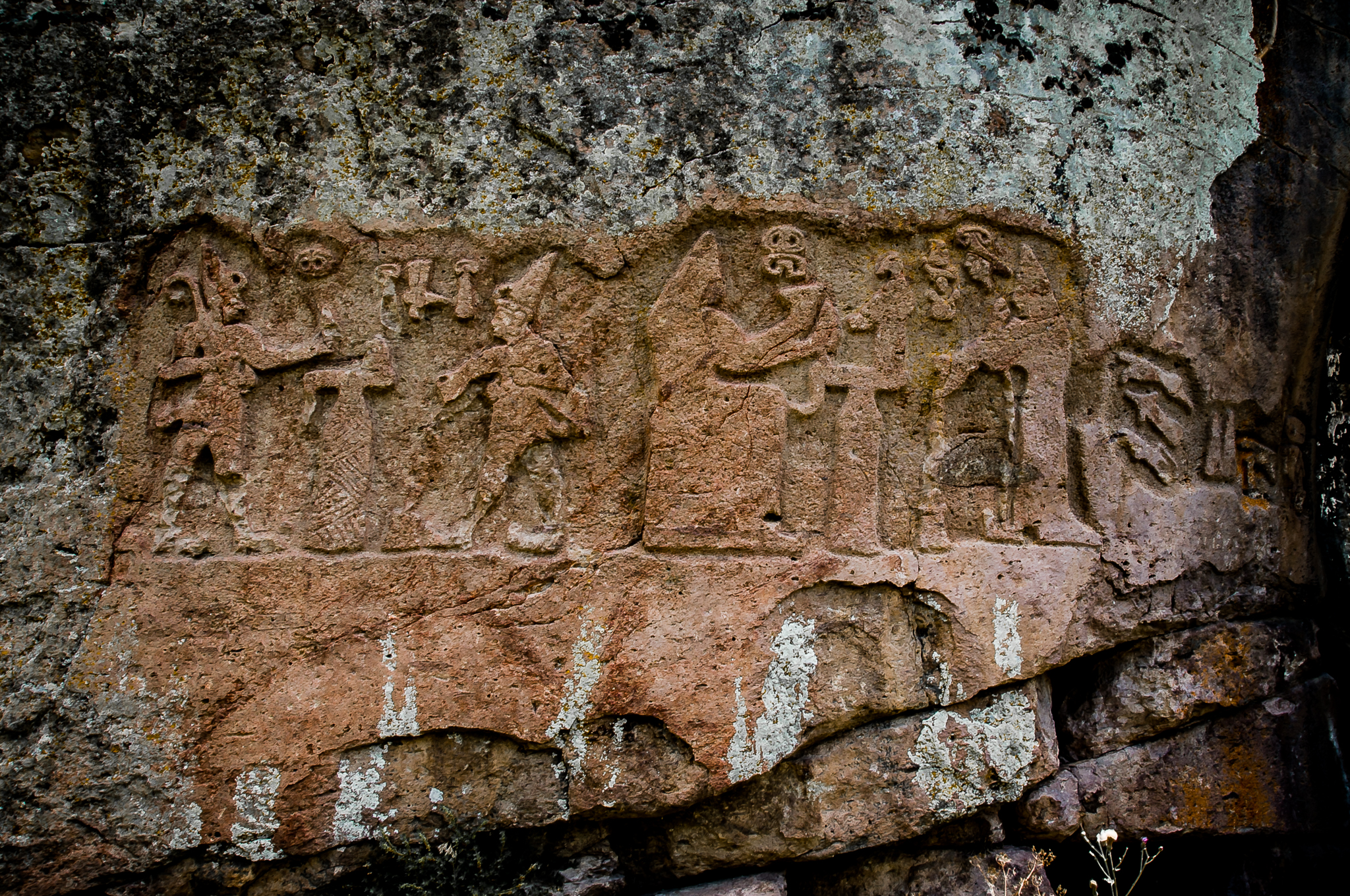
Hieroglyphic Luwian

ANCOZ 4

Text 151

Corpus
Hieroglyphic Luwian
Author
Commagene
Genre
hieroglyphic
Words
7
Sentences
3
Principal edition
Hawkins 2000a:348-349
Annotator

Text

How to read the glosses

The top row of each table gives the word form as transliterated. Below it, one column per morpheme, the six annotation levels follow in this fixed order. A heavier rule marks the word boundaries.

  1. 1Lemma — the dictionary entry the form belongs to, linked where an article exists
  2. 2Syllabic string — the syllabic spelling of the signs
  3. 3Logogram — the logographic writing, where one is used
  4. 4Translation — the meaning of the individual morpheme
  5. 5Morphological analysis — case, number, tense, person and the like
  6. 6Part of speech — noun, verb, particle and so on

§1]x-ha (*474)sa-ri+i-ia-si-sa á-sa-tá

Interlinear glosses
Annotation level]x-ha(*474)sa-ri+i-ia-si-saá-sa-tá
1Lemmasariyas(i)-as- (ti)
2Syllabic stringsariyasisasta
3Logogram*474
4Translationeunuchto be
5Morphological analysisnom sgpret act 3sg
6Part of speechsbst cvb

§2*a-wa/i-sa +LI-i[a?] ‹PURUS›.FONS.MI-i[a?]-ha p[i?]-n[a

Interlinear glosses
Annotation level*a-wa/i-sa+LI-i[a?]‹PURUS›.FONS.MI-i[a?]-hap[i?]-n[a
1LemmaawaasHattusili(ya)-Suppiluliuma-ha
2Syllabic stringawaasHattusiliyaSuppiluliumayaha
3LogogramHÁ+LI~HÁ~LIPURUS~FONS~MIPURUS~FONS~MI
4Translation(connective)(demarc. ptcl.)heHattusili (PN)Suppiluliuma (PN)and, also
5Morphological analysisnom cdat/loc sgdat/loc sg
6Part of speechptclptclpers pronsbst csbst cconj